

Chris Cain explains how to use ‘SRriIC’ to collect both technical and professional skills marks in the SBL exam.
I love helping ACCA students pass SBL. I do this partly by creating processes that students learn, practice and then apply in exams. This article introduces one of the most powerful processes I have created, and it is easy to memorise and apply – I call it ‘SRriIC’.
In SBL, students must be prepared to evaluate an NPV analysis which, based on examiners’ comments, appears to be a major weakness for many students. There are a possible number of reasons for this, but I will focus on how ‘SRriIC’ supports the process of answer planning sentences.
In this article I will show how ‘SRriIC’ can be applied to a part of Task 4(b), from the SBL March 2019 SmartWear exam, to collect both technical marks and professional skills marks simultaneously.
The SmartWear question can be found within ACCA’s Strategic Business Leader past exam resources, together with the examiner’s answer.
Task 4(b) required candidates to evaluate the marketing department’s NPV analysis (Exhibit 6) of a proposed investment in a customer database management system (CDMS). Students were also requested to question any underlying assumptions made by the marketing department in producing the NPV analysis. Although this task was only allocated 10 technical marks, it was very challenging for those who did not have a flexible structured approach towards undertaking an analysis and/ or evaluation.
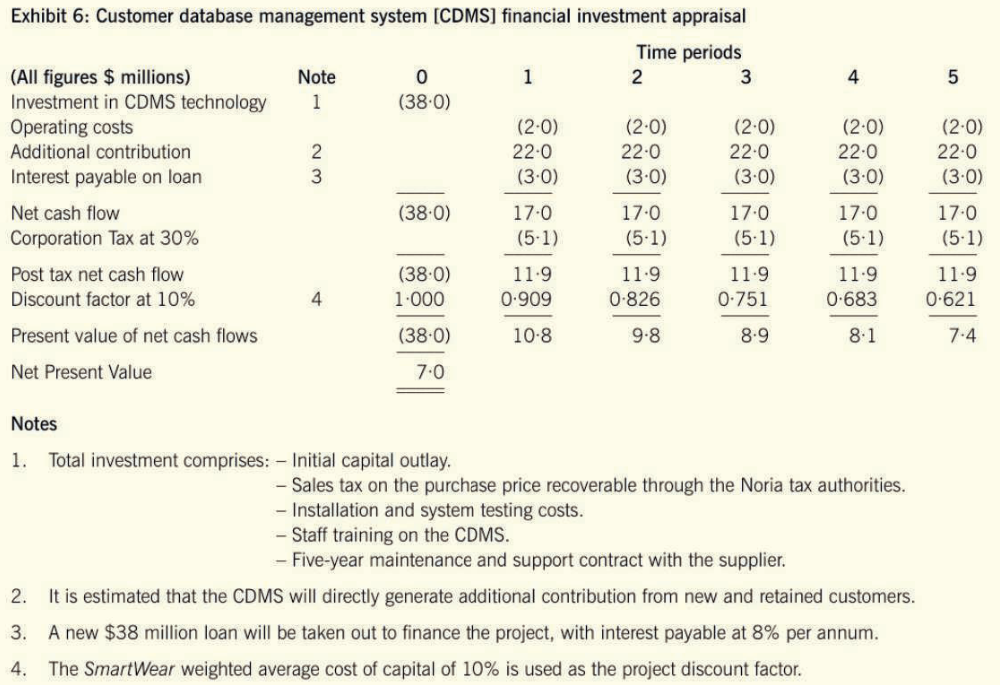
The proposed investment generated a positive NPV of $7 million. At first sight this appears attractive. However, strategic business leaders do not simply accept forecasts – they challenge them.
What is SRriIC?
The letters:
S – Statement
R – Reason (justification)
r – result in
i – impact on
I– implication(s) for
C – consequence(s) of

The SR is where students give an opening statement followed by a reason/justification.
The r and i link with the process of undertaking an analysis (convergent thinking).
The I and C are linked with the process of developing an evaluation (divergent thinking).
Please not: I do not advocate the application of every letter r, i, I and C when producing an answer on a single point (see below).
The Additional Contribution Calculation
The ‘Additional Contribution’ is given as a constant value of $22 million for five years.
The ‘SRriIC’ process could applied to structure planning as follows:
The Statement: “Additional contribution is unlikely to remain unchanged throughout the five years at $22 million.”
The Reason: “Because SmartWear’s forecast sales profile should be assumed by the marketing department to rise each year.
This is fundamental to the justification of the CDMS investment”.
Applying the r and i: “This is highly likely to result in inaccurate revenue forecasts and negatively impacting the reliability of the NPV calculation for the CDMS investment proposal.”
Applying the I and C separately: “One implication for the marketing department is to formally involve the finance team as a ‘business partner’ when undertaking an investment project proposal to ensure a commercially sound NPV analysis and the avoidance of errors.
“A possible consequence could be the reduction in shareholders’ value, rather than an increase as suggested by the current positive NPV of $7.0 million because of the wrong underlying assumptions being made by the marketing department.”
NOTE: Both the I letter and C letter do not have to be applied in the same discussion point on ‘additional contribution’ because the examiners will be looking for other elements in the NPV analysis to be discussed for 10 marks, such the omission of working capital in the NPV analysis?
The examiner’s answer identified several other assumptions that candidates should challenge, including constant operating costs despite inflation, the inclusion of interest within project cash flows, omission of potential tax allowances and the treatment of maintenance costs.
Do not assume that ‘SRriIC’ is purely a process for undertaking an analysis and evaluation. It also provides a critical thinking tool and creative thinking tool. This assists with the generation of ideas and, therefore, additional discussion points.
The Statement and Reason parts of the process help identify and explain technical issues. Consequently, students collect technical marks.
The Implications and Consequences parts in the process help demonstrate good communication, commercial acumen as well as evaluation. Consequently, students more easily collect professional skills marks.
This is particularly valuable in SBL because professional skills marks account for 20%. In addition, clearly demonstrating professional skills throughout the exam can result in technical marks being rewarded. I hope this brief insight into ‘SRriIC’ helps you in your studying of SBL and any forthcoming examination.
- Chris Cain, the creator of ‘SRriIC’, advises students on internship and volunteering experience as part of the ACCA Professional Experience Requirements (PER)
