

Teresa Clarke tackles a topic area that’s of special interest to Level 3 Business Awareness students.
The TARA framework is a tool that can be used to assess and manage risk.
It enables us to classify risks into two variables: the likelihood or probability of it happening, and the impact of it happening.
Likelihood or probability means the chance of it happening. For example, the likelihood of it raining in December in the UK is high. The likelihood of it raining in August in the UK is low.
Impact means the effect that it will have on the business. Getting rained on while out for a walk will have very little impact or effect as we can dry off when we get home. Getting rained on when we are studying in the garden with our computer, phone and all our books out may have more impact because all our books, computer and phone may get damaged and need replacing.
The acronym TARA means: Transfer / Avoid / Reduce / Accept
To use TARA to assess a risk, we need to look at the framework in a diagram.
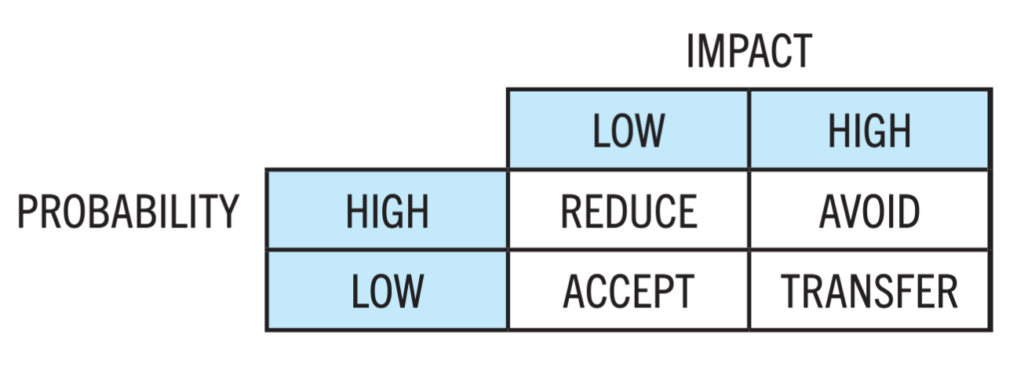
To transfer the risk means that the risk is shared with or transferred to another person or business.
To avoid the risk means the risk should be avoided completely.
To reduce the risk means reducing the risk to an acceptable level.
To accept the risk means that the outcome is more important than the risk.
Taking the example of studying in the garden in December in the UK, the probability of it raining is high. The impact of getting rained on is high. If we look at that in the TARA model, we can see that this activity should be avoided.
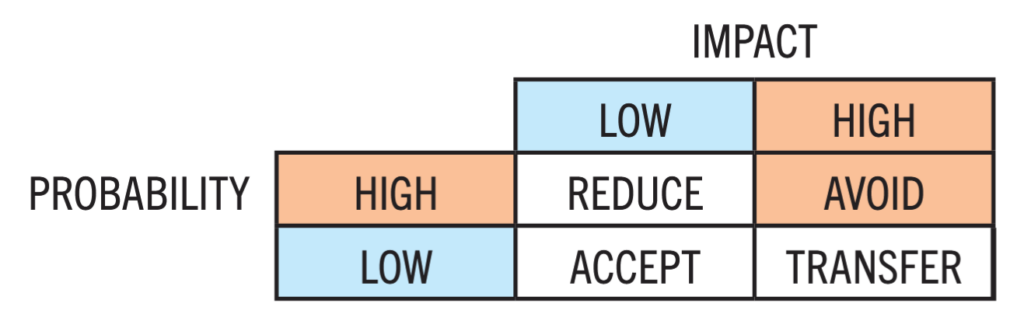
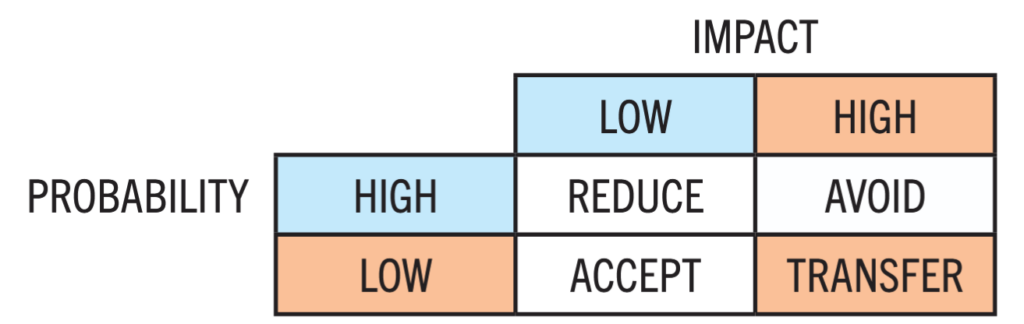
Taking the example of studying in the garden in August in the UK, the probability of it raining is low. The impact of getting rained on is high.
If we look at that in the TARA model, we can see that this activity suggests we transfer the risk. So, we could still study outside, but make sure that we have insurance to cover any damage caused by doing so.
This is only a fun example, so let’s just do one more with a business scenario.
Your building company has been offered the job of dismantling redundant wind turbines just off the coast of Norfolk. A risk assessment has been carried out and it has been confirmed that all safety precautions have been put into place to protect the employees, and the only possible risk identified is of the employees slipping when climbing back into the boats at the end of the day, potentially causing minor injuries. The risk assessment has identified this as a likely hazard.

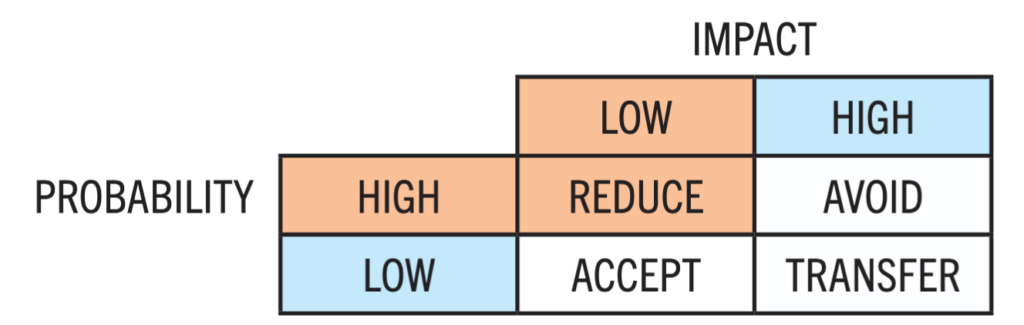
The TARA model suggests that we should reduce the risk. We could do this by ensuring that all employees wear non-slip shoes, or the walkways be covered in a non-slip surface.
Try to think of a scenario for a business decision and use the TARA model to help you decide to deal with the risk.
